



Story
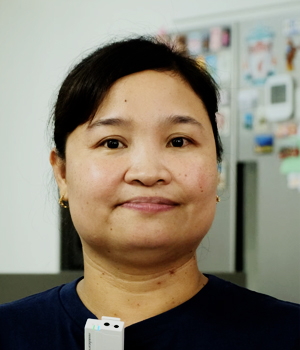
Maria Teresa
Maria Teresa
As a "mother” to her two brothers growing up while her mother left for work in a foreign land, Maria Teresa was mature and independent from a young age. There is not much for life in her hometown in the Philippines, working on land her family does not own, only having to pay for their portion of the harvest at the end. Her family had an inadequate amount of money for healthcare. One morning when Maria was 11, she heard screaming on the first floor of the boarding house her family lived in. She rushed down the stairs and saw her brother crying in pain holding out his disfigured limb as the boiling hot water ate at his skin and the kettle at the ground.
It was hard to afford healthcare and other forms of insurance when the food on their table was well-fought for. As an adult, Maria has three children, two boys and one girl. Without money, nothing good can really happen to them. In her own words, "Whatever they plan, I told them I will support them so I sacrifice for them.”
Knowing that it’s with her sacrifice that her family will have a better life, she left her home and decided to follow in her mother’s footsteps.
In Kuwait, in the Middle East, where she first began her work as a domestic worker, she was originally hired to take care of the elderly and some disabled people in a family. However, the truth was that she was expected to take care of a larger group of people, the rest of the family. She needs to take care of and cook for six children instead of her own children back home. As if it weren’t enough, she needs to cook meals (often spontaneously) for 10+ people daily.
As she was working in a few years at the time, Maria's mother was diagnosed with ovarian cancer, she was forbidden by her employer to go and see her. "So I really panic. I really want to see her," she said. At the brink of dread and trepidation, she stole the keys for the doors and tried to escape.
She couldn’t.
She couldn't because she was caught by her employers and got her inhumane punishment. It was a terror sight as she got beaten repeatedly by them. Whilst this physical assault, the pain in her body was nothing compared to the dread she felt in her heart as she was prevented from seeing her sick mother. "I don't mind get beaten. But as long as I can see my mom, but still nothing happens.”
Maria doesn't have the right to sue her assailants, she has no power to sue or break the four year contract with them, she was trapped in one of the many horrible situations faced by a migrant domestic worker.
She needed the salary of three months to pay for a ticket home, where her family receives remittance from her each month. But she needed to go back. Her employers, ordered her to leave everything valuable to her except her passport and documents in their home so they can hold a guarantee that she'll be back. It was unlikely.
The agency went looking for her, employers in Kuwait begged her to go back. But after everything she experienced, she would not return.
Looking for an alternative path, she came to Hong Kong after her friends recommended the choice to her. The salary was higher, and it held better circumstances than the Middle East, so it seemed like a good idea.
In Hong Kong, she would work as a domestic worker for 4 different employers, for 17 years. The first one is eight years, because they decided not to get any help or anymore, because her work is already big enough. And then employer went to Australia to study so they don't need her. And the second one is four years in North Point. They are retired already. So they want to take care of themselves.
The third employer is a rich family with kids in a big house.They have high expectations on the tiny details of the domestic work that's done around the house. For example, it would be a big issue for them if she didn't close the windows at night. She needed to make dumplings from scratch for the family during lunchtime, prepare the food, and doing a lot of work that requires lots of standing. It was especially difficult for her, her feet were swollen all the time, and it was hard for her to stand. She was also expected to stick to a strict timetable for her tasks. Even as her body, diagnosed with thrombosis at the time and causing her extreme pain, didn't cooperate with her job, it was important for Maria to finish the contract.
Now at forty-four years, Maria plans to open a business when she returns home in the Philippines.