



Story
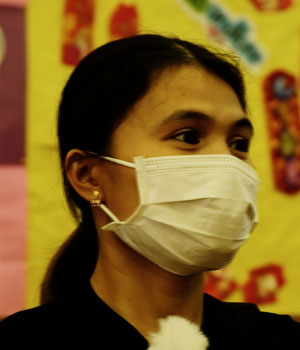
Angie
Angie
Reviewing back her life, Angie found that she had always been a missing piece of the puzzle in her family. She told us she had three children but no husband: “My children get hurt. They don’t want a broken family. But as days go by, they can only face the cruel and inevitable reality.”
Angie left her hometown, Philippines, and came to Hong Kong for nine years. From that time, she had already had three employers. The job duties and daily routines of a domestic worker seemed to be looping like a never-ending circle. “I do house laundries, not much cooking, and I take care of the kids.”
Everything about the first employer was good up until when the employer broke the contract due to financial problem. The second employer didn’t satisfy Angie. She had to tolerate the fuss and criticism of the grandmother in the employer family. “Most of the time, she's angry with something that I don't know,” Angie told us, “and I have to take care of a newborn and a two year old. Tt’s like she (the grandmother) is always shouting something that I really don’t understand and I have to focus on the children.” She left after working there for 4 years and found another employer. Dealing with a relationship between the employer and her, a domestic worker, had always been a question to Angie. As an employee, people often forgot the fact that she was also a professional domestic worker- although some people might found it sneering calling a domestic worker “professional”. The grandmother in the third employer home was manipulative. “She wants to manage everything. For example, you already have the floor cleaned. And then after a minute, she will come there and then rearrange it,” Angie added, “maybe she wants her style to be done by me. But of course, I have my own style of working.” However, when we asked for the experiences Angie had with the previous employers, she kept emphasizing that “Most of my employers love us. They are good people”.
Angie seemed to be grateful and satisfied with her job of domestic helping. However, as we were preparing to delve deeper into the relationship between employers and employees, Angie told us her frustrations while working in the employer house. “We have enough food allowance,” she said, “they will just give you the reheated food from over last night and that would be lunch.” Privacy is another underlying problem domestic helpers worry about. “The contract noted the employer will provide employees with a separate room.” Despite that, Angie still had to follow the timetable of the employer and his/her family, “ Sometimes the kids do the homework until 11pm, which makes it impossible to sleep. You have to wait if the light is close if they are finished with their work.”
Domestic helpers, especially immigrants, don’t receive the respect they deserve, and some are even being suspected by employers for no particular reason. Angie told us a story about her friend, another Filipina domestic helper. She was wrongly held guilty for stealing money from the employer she worked for. No rumors were confirmed yet, and Angie and her friends could do nothing about but wait until somebody, the Filipina’s consulate perhaps, to bail the Filipina out.
Working as a domestic helper in Hong Kong wasn’t an easy job, yet Angie still had a family to feed. “My family don’t want me to work in HK because it's hard that they don't have mother and father inside the house,” Angie shrugged, “But they have no choice but to accept it.” The struggle of balancing family and work had been troubling Angie for years. Angie was proud when she told us that her daughter was in college. We could see the sudden sense of loss flow through her face as she said the words.
However, she stilled claimed that she liked working in HK and had not yet planned to go home. “Because I still have that 14 years old (kid in the employer house) who wants to study in college in 10 years. I'll keep on working and if they need me I will support them.” She smiled hesitatingly. Immigrate helpers like Angie had insurance given by the government. The Philippine consulate supported them with financial and education insurance after the helpers signed the contract. Angie seemed to be pretty satisfied with the insurance supplied by either government or the employer.
However, policies introduced for the domestic helpers were not all humanized. The helpers would face unemployment if they didn’t find their employer within 14 days after the previous contract terminated. “We fear that if we terminate the contract and don’t find the employer in time, we will be send back home.” Angie said depressingly. Being sent back to Philippine meant the termination of income. And the termination of income would be disastrous to helpers like Angie, who was the main support of their family, as it implied to deplorable living condition and even hunger.
During the interview with Angie, a Filipina who came far away from east Asia to Hong Kong, we found that she was grateful to her job and her life. The society is still filled with contempt and disrespect towards domestic workers, sadly. However, when we offered Angie the chance to jump out her identity of being a domestic worker and asked her what she would do for them, she said after a long pause: “I think if I have a million dollar I, I will put some organization teaching each of one how to manage their earnings and make a living in the Philippines so that they will not work abroad anymore. Far from there country.”