



Story
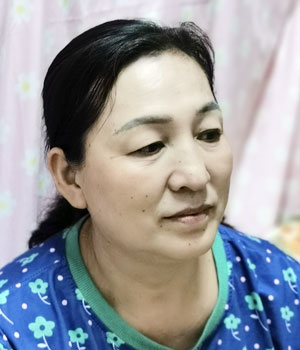
Liu Xing
Liu Xing
In the lobby of her employer’s apartment building, sat back-faced to the afternoon sun, there was the noise of children playing in the background, Auntie Liu began her interview.
Like many domestic workers, especially those who have left home for a different region to work, she was the eldest of the three sisters in her family. She grew up in a poor town in Hu Nan, where education was scarce, and money could only be best earned through labor.
At fourteen, in the year 1994, having not been able to go to high school, she and many other girls were sent to cities to do housework and chores for strangers to earn a living. Auntie Liu worked for four different factories in ten years and remittances were sent back to her younger sister’s education, and years later, to her own children.
Naturally, after a decade of working in a factory, it was time for her to go home, temporarily at least, to get married and have children. She had one boy and one girl. Not long after, she went back to the city to work as a domestic helper. Her husband was also working—in a different city. Their children live inside the school or are taken care of by Auntie Liu’s parents back home. Sadly, entangled between the role of parents and workers, they could only visit them once a year during CNY. Their medium of contact during the rest of the year was through WeChat, a popular app for communication in China, which they seldom use. When asked if she missed the kids, she took a long pause, hesitating in her response. She did miss them, but what can I do? It can’t be helped, can it? We’ve got to earn money! The more money we make the sooner we can go back.
However the unideal circumstances, there was fulfillment in her work as a domestic worker. Auntie Liu explained that it helped her to be able to give money to her family, and there was a certain amount of freedom in her work that made her happier. In her free time, she liked to sing. She sang to entertain herself, and it was a long-term hobby. In the warm glow of the summer sun, with children playing not far away, she played music on her phone and sang 沉默是金, which translates to "silence is gold". It was about the significance of not arguing or fighting back when faced with persecution or false accusations.
When she finished the song, she left to buy groceries for dinner.
Douyin is a widely used platform to share content in China, as a domestic worker, she used it to document her life. She often sat in her tiny room of her studio apartment after working hours, editing her videos and posting them onto the platform. This was a task on which she spent 3-4 hours doing. It was much freer, and she had more choice of doing what she wanted when she was not working.
After half a year, she gained 100 hard earned followers. In her break times, she would look through hers and other people’s videos. She would either post her own videos in the morning or at night.
She would record herself cleaning her employer’s house or some other daily activities. As she did not live in her employer’s house, she worked 7-8 hours a day for 40 yuan an hour and rested on the weekends.
In her work, she cleaned houses, and cooked food for the family, in which she would eat in the kitchen of their house after refusing to eat at the same table with the family.
